IPTV Strong is a search phrase people often use when they are trying to find a Strong 8K-style television subscription, compare sellers, understand which player to use, or decide whether the service is worth testing. The confusing part is that the Strong name can appear across several websites and reseller pages, and those sellers can advertise different channel counts, prices, device support, guarantees, and account configurations. That means one page using the Strong name should not automatically be treated as identical to another.
The useful way to evaluate IPTV Strong is to ignore the biggest marketing numbers at first and focus on what you can verify in your own home. Do the channels you actually watch exist? Does a major sports event remain stable? Does the Electronic Program Guide show useful information? Does the player feel responsive on your real television or streaming device? Can the seller answer a simple question before you pay? Those practical checks tell you far more than a claim about tens of thousands of channels or a large resolution badge.
If you are considering Strong8KTVs, start with the Strong8KTVs channel list and identify the channels that matter to you. Then use the Strong8K free trial on the exact device and internet connection you expect to use later. A short, controlled test gives you a much stronger basis for judging IPTV Strong than another person’s review because your network, player, hardware, viewing habits, and priority channels are different from theirs.
Table of Contents
What Are You Really Buying With IPTV Strong?
Before judging the service, separate the setup into the parts that make the experience work. The subscription provides access to the streams. The IPTV player organizes those streams into channels, favorites, categories, movies, series, and EPG information. The seller or reseller handles the account, activation, support, renewal, and sometimes the way regional categories are configured. Your own device and network then determine how smoothly the entire setup runs.
This matters because each part can fail independently. A subscription can be active while the player has a bad configuration. A good player can feel slow on an old streaming stick. A strong internet connection can still experience problems if one source feed is unstable. IPTV Strong should therefore be evaluated as a complete chain instead of treating every problem as proof that the service itself is bad.
The same logic helps with buying decisions. If the player is the only thing you dislike, you may not need a different subscription. If the account works on one device but not another, the second device deserves attention. If every supported player and device fails on the same streams, the provider or source becomes a stronger suspect. Understanding these layers keeps the service troubleshooting much more focused.
How Many of the Advertised Channels Will You Actually Use?
Large channel counts are easy to market because five-digit numbers look impressive on a sales page. In reality, most households repeatedly use a much smaller group of local channels, sports networks, news stations, entertainment, children’s programming, movie channels, and international feeds. IPTV Strong is only useful when those specific channels are present, correctly labeled, and reliable when you want to watch them.
Raw totals can also be inflated by regional versions, backup feeds, SD and HD variants, event channels, duplicate network feeds, and categories from countries you may never open. Those duplicates are not always useless. Backup streams can be helpful during live events, and regional versions can matter to some viewers. But they should not convince you that a service is automatically better simply because the number is larger.
Use the Strong8KTVs channel list to create a short priority list before testing IPTV Strong. Divide your viewing into essential, regular, and bonus content. Essential channels are the ones that would make you reject the subscription if they were missing. Regular channels are watched often but are not deal-breakers. Bonus channels are useful extras. This simple structure makes it easier to judge the service without getting distracted by the entire catalog.
Priority
What It Means
What to Check During the Trial
Essential
You would not subscribe without it
Availability, stability, correct labeling
Regular
You watch it frequently
Startup speed and picture quality
Bonus
Nice to have
Browse only after essentials pass
The right subscription is not necessarily the one with the most entries. It is the one where your important content works well enough that you stop thinking about the catalog size.
Does the “8K” Label Tell You Anything About Real Picture Quality?
The Strong ecosystem frequently uses labels such as 8K, 4K, UHD, Full HD, and HD. Those labels can describe branding, available quality tiers, or individual streams, but they should not be interpreted as proof that every IPTV Strong channel is native 8K. The final image depends on the original source, encoding, bitrate, player, device, network conditions, and television. A display can also upscale lower-resolution video, which is different from receiving a native high-resolution source.
The practical test is much simpler than the marketing language. Watch a channel for a meaningful period and ask whether the picture looks clean on your television, motion remains smooth, compression is acceptable, and audio stays synchronized. Sports can expose motion problems quickly, news can reveal soft text and compression around graphics, and dark movie scenes can show blockiness that is easy to miss on bright content.
Stable Full HD or 4K can provide a much better experience than a higher-resolution label that repeatedly buffers. When testing the service, picture quality should be judged by what reaches your screen during normal use, not by the largest number written in the product name.
Can IPTV Strong Handle the Live Sports You Actually Watch?
If football, boxing, basketball, Formula 1, UFC, NFL, NHL, or another live sport is one of the main reasons you want IPTV Strong, sports should be part of the trial rather than an afterthought. A quiet daytime channel does not recreate the conditions of a major event. Popular live matches can expose peak-time congestion, unstable sources, audio delays, frame-rate problems, and slower channel recovery much more clearly.
The question is also not simply whether the service has a sports category. Different viewers need different leagues, countries, networks, and events. Someone following Premier League football has very different priorities from someone who mainly watches NBA games or combat sports. Build the sports test around your actual viewing rather than accepting the word “sports” as enough evidence.
Use a Busy Live Event as Your Real Stress Test
During the IPTV Strong trial, watch at least one event that matters to you if the timing allows it. Pay attention to how quickly the stream opens, whether motion remains smooth, whether commentary stays synchronized, and what happens if the stream briefly fails. If backup feeds are available, see whether they are easy to locate and whether the player lets you switch without getting lost in the full playlist.
A successful test does not mean every future event will behave identically, but it gives you evidence from a much more demanding situation than a random channel at an easy time of day. That is especially important before paying for a longer plan primarily for sports.
How Much Can the Player and Device Change Your Experience?
The player can change how IPTV Strong feels even when the underlying account stays exactly the same. The subscription supplies the streams, while the player controls categories, favorites, guide data, movies, series, search, and playback controls. Two people using the same service can have different experiences because one player loads quickly and organizes the playlist well while another feels slow or awkward.
Your device matters just as much. A modern Android TV box or Fire TV device with enough free storage and memory can handle large playlists and EPG databases more comfortably than older hardware. A phone may run the same account smoothly while an aging Smart TV app struggles to open categories. That does not automatically mean the service is unreliable; the device can be part of the bottleneck.
Always test the account on the hardware you actually plan to use. If your living room setup is a Firestick, the trial should happen on that Firestick rather than only on a phone. If a player feels slow, compare another compatible player before deciding the entire subscription is the problem.
M3U and Xtream Logins Need the Right Setup
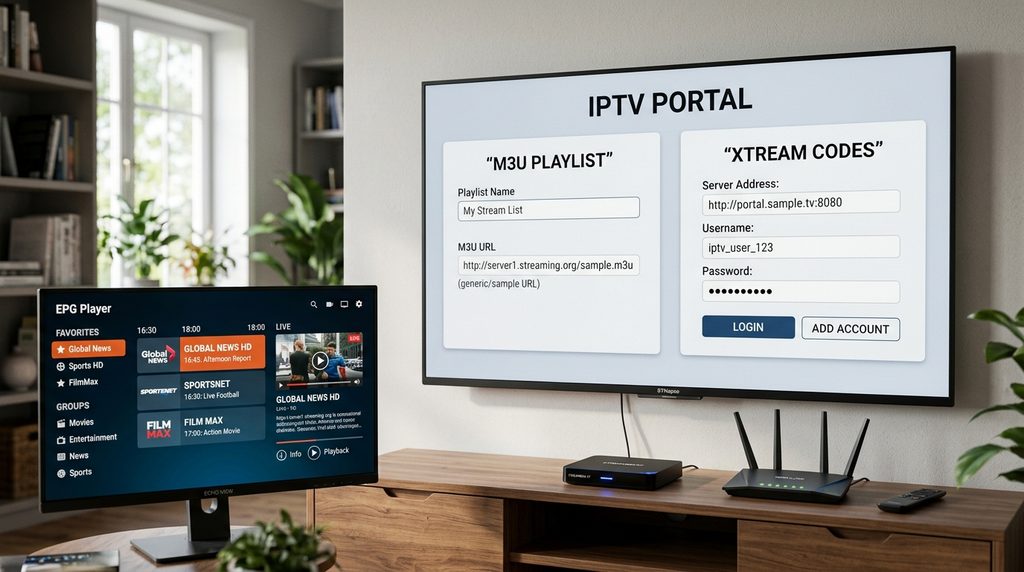
Most IPTV players expect a specific login format. An M3U setup usually uses a full playlist URL and can include a separate EPG address. An Xtream-style setup normally separates the server address, username, and password. IPTV Strong accounts can be distributed in either style depending on the seller and player.
Enter the credentials exactly as provided. An extra space, missing character, wrong protocol, or server address copied from an unrelated tutorial can stop the playlist from loading even when the subscription is active. If the login screen does not match the information you received, ask the seller which setup method should be used instead of guessing.
Keep these details private as well. M3U URLs can contain usernames and passwords directly inside the address. When requesting help with the service, share the error message and device model while hiding private server details, complete playlist links, usernames, and passwords.
Will the EPG and Favorites Make Daily Viewing Easy?
A giant playlist becomes tiring when it is poorly organized. The Electronic Program Guide is what can make IPTV Strong feel closer to a normal television experience because it shows what is playing now and what comes next. Favorites reduce the need to scroll through hundreds of categories every evening. These features may sound less exciting than channel counts or resolution claims, but they have a much bigger effect on daily convenience.
Do not judge the service by the first screen after login. Spend time moving between channel groups, opening the EPG, searching for content, creating favorites, and restarting the player to make sure the settings remain. If guide data is frequently missing or badly matched to channels, note that before buying a long plan. If the guide is accurate enough and favorites are easy to reach, that is a real strength.
Organize the Playlist Before Judging the Service
Create a favorites group with the channels your household uses most. Hide countries or categories you never watch if the player allows it. Put sports, local television, news, entertainment, movies, and important international channels somewhere easy to reach. Once the IPTV Strong playlist is organized, you can judge whether the everyday experience is actually comfortable.
This also helps you separate service quality from interface clutter. A large catalog can look overwhelming before it is organized, while the same account may become simple once most daily viewing happens through one favorites list.
When IPTV Strong Buffers, What Should You Test First?
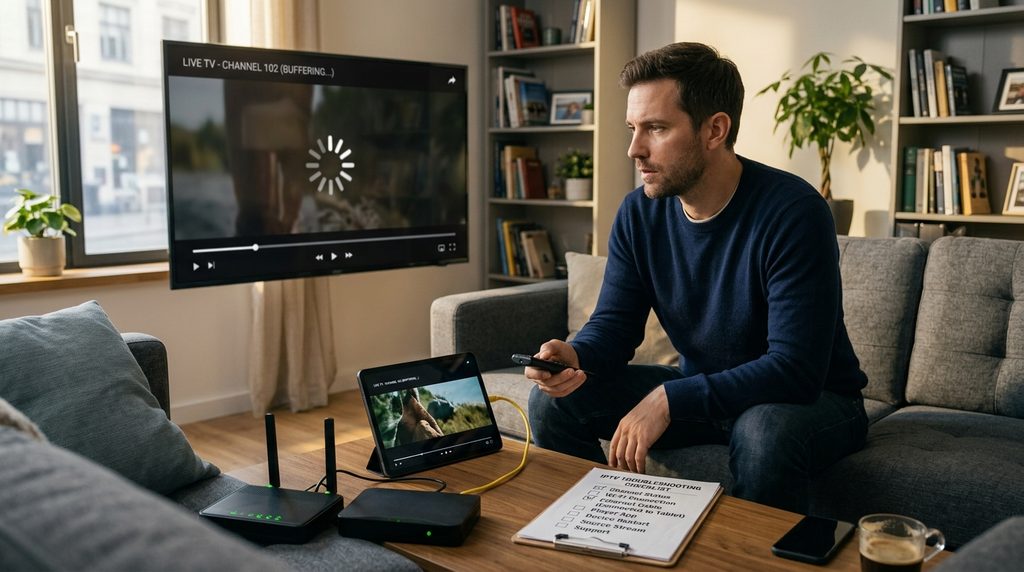
Buffering is one of the most common streaming complaints, but IPTV Strong is only one link in the chain. Weak Wi-Fi, router congestion, background downloads, ISP routing, VPN performance, device memory, decoder behavior, player configuration, and the source feed can all create freezes that look almost identical on screen. Reinstalling the player immediately does not tell you which part is responsible.
Start by checking whether the problem affects one channel or many. Then compare another channel, restart the stream and device, verify that normal internet services work, and try Ethernet if it is available. Pause large downloads or cloud backups. If possible, load the same IPTV Strong account in another compatible player and compare the same problem channel.
Change One Variable at a Time
Test another channel from the same category.
Try a channel from a completely different group.
Restart the stream and player.
Restart the television or streaming device.
Check another video service on the same hardware.
Compare Wi-Fi with Ethernet when possible.
Pause large downloads and cloud backups.
Try another compatible IPTV player.
Test a second supported device.
If one player buffers while another handles the same stream smoothly on the same device and network, the first player deserves more attention. If every player and device struggles with the same channels while other internet services work normally, the provider or source becomes a stronger suspect. The important thing is to avoid changing the player, network, device, VPN, and credentials all at once because then you will not know which change actually helped.
How Do You Judge the Seller Before Paying for a Long Plan?
Seller quality matters because Strong-branded subscriptions can be offered through different websites and resellers. Those sellers may handle activation, account configuration, regional categories, renewal, replacement credentials, connection limits, and support differently. Even when two sellers describe the product as IPTV Strong, the buying experience can vary.
Before paying for a long plan, ask one genuine question. Ask whether your main device is supported, whether a particular country or sports group is included, how many simultaneous connections the plan allows, or whether renewal keeps the same account. The answer gives you information about both the subscription and the seller’s willingness to communicate.
If you are considering Strong8KTVs, use the Strong8KTVs contact page to clarify anything important before paying. Good communication does not guarantee that every stream will be perfect, but poor communication before purchase is a useful warning sign because account problems are much more frustrating when you cannot get a clear response.
The Strong8K free trial should also be treated as a seller test. Do not use it only as free entertainment. Confirm that your priority channels are present, the account works on your main device, sports perform under realistic conditions, the EPG is usable, VOD is organized, and the seller can answer a relevant question. A trial that passes those checks gives you much better evidence than a sales page.
When Does IPTV Strong Become Good Value?
Price should come after performance. A cheap yearly IPTV Strong subscription is poor value if the channels you care about fail every weekend. A more expensive plan is not automatically better simply because the seller charges more. The value comes from whether the service reliably delivers the content your household actually uses and whether the seller provides enough support to keep the setup practical.
After testing, compare the Strong8KTVs pricing plans and choose a duration that matches your confidence. A shorter plan can reduce commitment while you learn how the service behaves over time. A longer plan may offer a lower effective monthly cost, but it also creates more risk if the seller, service, or your own viewing needs change.
Area
Potential Strength
What You Still Need to Verify
Live channels
Broad international selection
Your must-have channels
Sports
Multiple regional feeds
Peak-event stability
Picture quality
HD, FHD, 4K and higher labels
Actual source quality on your TV
VOD
Large movie and series libraries
Search, organization, playback
Players
Several compatible app choices
Performance on your hardware
EPG
Program-guide support
Accuracy and completeness
Support
Seller assistance
Response quality before purchase
Pricing
Different plan durations
Value after the trial
The biggest mistakes are buying IPTV Strong because of the largest advertised channel number, assuming the 8K label describes every source, choosing the longest plan before testing, or changing several technical settings whenever one problem appears. The better approach is to test what matters, keep the setup simple, and let the real viewing experience decide whether the price is justified.
Frequently Asked Questions About IPTV Strong
Is IPTV Strong the same as Strong 8K IPTV?
The terms are commonly used to describe the same broader Strong 8K-style service ecosystem, but several sellers and websites can use Strong branding. Because account configurations, prices, support, and channel groups may differ, verify the exact package you are considering instead of assuming every listing is identical.
Does IPTV Strong really provide native 8K?
The service can be advertised with several quality labels, but the Strong or 8K branding should not be treated as proof that every channel is native 8K. The source feed, encoding, bitrate, player, device, network, and display determine the real image. Judge IPTV Strong by actual playback on your television rather than the label alone.
Can I use IPTV Strong on Firestick?
Strong-related sellers advertise support for Fire TV and Android TV devices, and several IPTV players are designed for Android-based television hardware. Test IPTV Strong on the exact Firestick you plan to use because older devices can become slow when loading large playlists, VOD artwork, and EPG databases.
Should I buy a one-year plan immediately?
Testing first is usually the more sensible approach. Verify priority channels, sports, picture quality, EPG, device performance, seller communication, and connection limits before choosing a longer IPTV Strong subscription. A short plan can also give you more time to learn how the service behaves outside the initial trial.
How many channels should I test during a free trial?
You do not need to test hundreds. Choose roughly ten to twenty channels that represent your real viewing, including essential live channels, sports if relevant, and a few different categories. A focused IPTV Strong trial gives you better information than opening every channel for a few seconds.
What matters more: channel count or EPG quality?
For daily use, EPG accuracy and easy organization can matter more than the raw channel number. A smaller set of reliable channels that you can find quickly is usually more useful than a huge IPTV Strong catalog that requires constant scrolling and contains poor guide information.
Is IPTV Strong Worth Trying in 2026?
IPTV Strong can be worth testing for viewers who want live television, international channels, sports, movies, series, and flexible player options in one subscription. The Strong name is used across different sellers and websites, so the exact claims about channel totals, device support, pricing, and account configuration can vary. That is precisely why a personal trial should carry more weight than the sales page.
Start with the Strong8KTVs channel list and identify the channels you genuinely care about. Use the Strong8K free trial on your real television or streaming device, test sports during realistic conditions if they matter, organize the EPG and favorites, and compare another compatible player if you need to determine whether a problem belongs to the app or the service.
Pay attention to the seller as well. Ask a real question before committing, clarify connection limits and renewal terms, and use the Strong8KTVs support page when something important is unclear. Once IPTV Strong performs consistently under your own conditions, compare the pricing plans and choose a duration that matches how confident you are in the setup.
The strongest reason to subscribe should not be the largest channel count or the biggest resolution badge. It should be that the channels your household genuinely watches are available, playback is stable enough during real viewing, the player is easy to use, and the seller provides enough support for the service to remain practical after the first week.